
Wheel Alignment Versus Wheel Balancing Explained

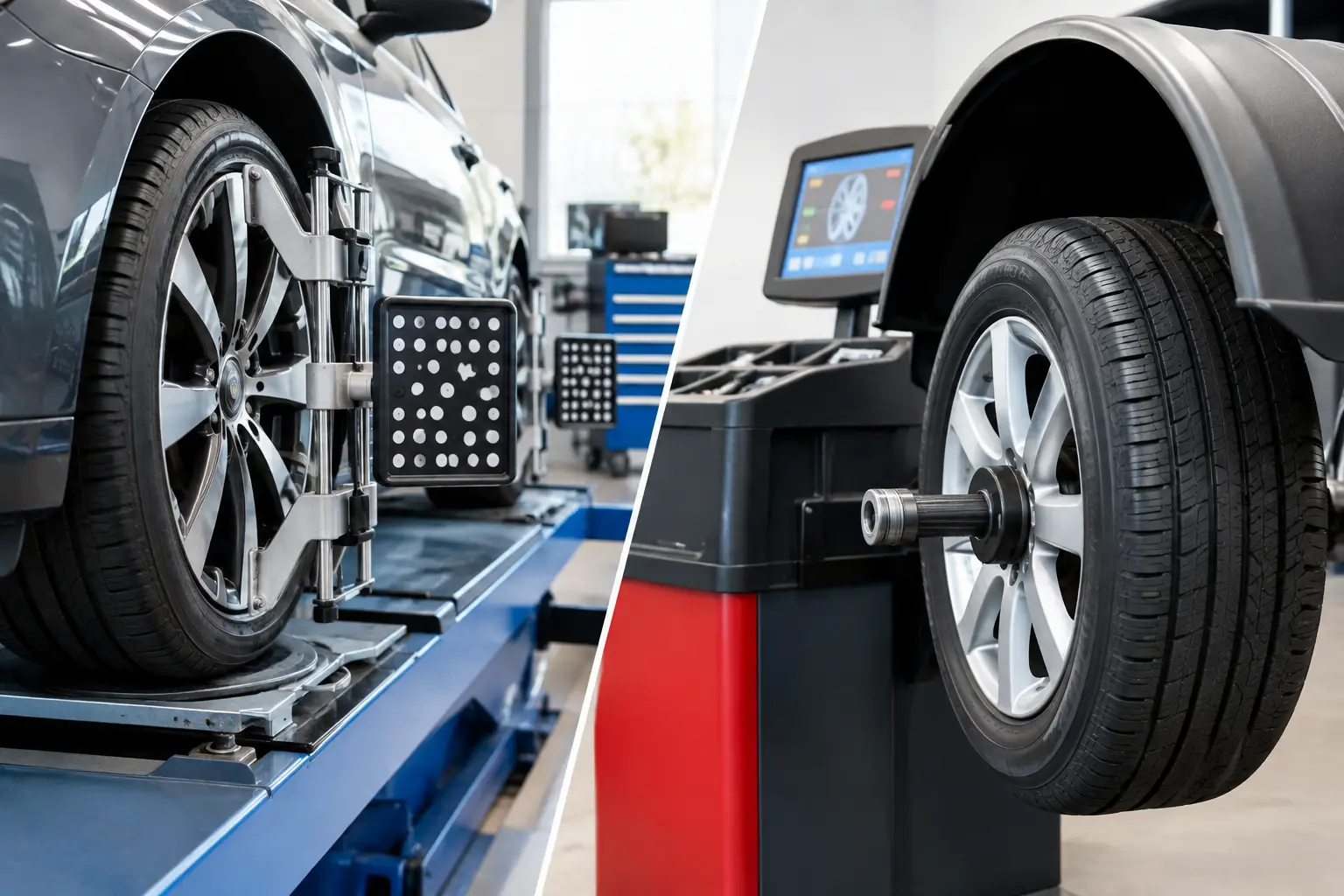
A steering wheel that sits crooked, tyres wearing through on one edge, or a shake appearing at motorway speed can all make a car feel overdue for attention. Yet the fix is not always the same. Wheel alignment versus wheel balancing is a common point of confusion because both services affect how your car drives and how long its tyres last, but they correct entirely different problems.
Balancing deals with the weight distribution of each wheel and tyre assembly. Alignment sets the angles at which the wheels meet the road. One can be perfect while the other is well out, so replacing tyres or fitting a new set of alloys does not automatically solve both.
Wheel alignment versus wheel balancing: the key difference
Wheel balancing is carried out one wheel at a time. A technician mounts the wheel and tyre on a balancing machine, which spins it and identifies where weight is unevenly distributed. Small balancing weights are then fitted to counteract that imbalance.
Even a minor imbalance becomes noticeable as wheel speed rises. At lower speeds, the force may be too small to feel. At 60 to 70 mph, it can translate into a vibration through the steering wheel, seat or floor, depending on which wheel is affected.
Wheel alignment, sometimes called tracking, is about the direction and angle of the wheels relative to the vehicle and to each other. It is measured against the manufacturer’s settings and adjusted through the suspension steering geometry where adjustment is available. The aim is for the tyres to roll straight, share the load correctly and maintain the intended contact patch with the road.
The distinction matters because balancing will not cure a car that pulls to one side, and alignment will not remove a speed-related steering vibration caused by an out-of-balance wheel.
What wheel balancing corrects
A wheel and tyre are not naturally identical in weight all the way around their circumference. Tyres have heavier and lighter areas, as do alloy wheels, valves and tyre pressure monitoring sensors. Fitting a tyre can create enough unevenness for the driver to feel it, particularly on larger-diameter wheels or lower-profile tyres.
The balancing machine measures this unevenness precisely. Adhesive weights are commonly used on the inside of alloy wheels to keep the face tidy, while clip-on weights may be suitable for certain wheel designs. The correct method depends on the wheel and where the machine identifies the imbalance.
A balance issue most often causes a repeated vibration that changes with speed. If it is felt mainly through the steering wheel, the front wheels are likely involved. A vibration through the seat or vehicle floor may point towards a rear wheel, although tyre condition, wheel damage and suspension wear can produce similar symptoms.
Balancing is particularly worthwhile after fitting new tyres, swapping seasonal wheels, repairing a puncture, replacing a valve or removing and refitting a tyre. It should also be checked if a balancing weight has come off. Kerb contact, poor road surfaces and corrosion around the wheel can all contribute to problems, especially on older alloy wheels.
A wheel that is bent or a tyre with a distorted casing cannot always be cured with weights alone. The machine may show that the assembly needs an unusually large amount of weight, or the vibration may remain after balancing. In that case, the wheel should be inspected for run-out, cracks and previous repair quality, while the tyre should be checked for bulges, flat spots and uneven wear.
What wheel alignment corrects
Alignment focuses on the suspension and steering geometry. The main measurements are toe, camber and caster, although the exact checks and adjustment options vary by vehicle.
Toe describes whether a pair of wheels point slightly towards each other or away from each other when viewed from above. Incorrect toe is one of the most common causes of rapid tyre wear. A relatively small error can scrub rubber from the inner or outer edges over surprisingly few miles.
Camber is the inward or outward lean of the wheel when viewed from the front. Some vehicles are designed with a small amount of negative camber for handling, particularly performance models. Too much or too little can place more load on one shoulder of the tyre and reduce the usable contact area.
Caster is the fore-and-aft steering-axis angle. It contributes to straight-line stability, steering feel and the steering wheel’s tendency to self-centre. It is not adjustable on every vehicle, but measuring it can reveal the effect of accident damage, worn components or a shift in the suspension.
Alignment can move out after hitting a pothole, striking a kerb, replacing suspension or steering parts, lowering a vehicle, or fitting wheels and tyres that change the vehicle’s setup. It may also alter gradually as bushes, ball joints and track rod ends wear.
A proper alignment check is more than adjusting the front tracking. Modern cars often require four-wheel alignment, where the rear axle position is measured first and the front is set to follow the vehicle’s true thrust line. This is especially relevant on vehicles with independent rear suspension and on premium models where tyre costs make incorrect geometry an expensive problem.
Signs that point to alignment rather than balancing
Uneven tyre wear is the clearest clue. Excessive wear on the inner or outer shoulder often indicates an alignment issue, though damaged suspension parts, incorrect pressures and aggressive driving can contribute. Feathering, where the tread feels smooth in one direction and sharp in the other, is commonly associated with incorrect toe.
You may also notice the car pulling left or right on a level road, a steering wheel that is off-centre when travelling straight, or a vehicle that feels unsettled after a pothole impact. These symptoms justify an inspection, but they are not proof on their own. Road camber, tyre pressures, tyre construction and even a sticking brake can cause a pull.
Before adjusting alignment, a competent workshop should check tyre condition and pressures, wheel security, steering and suspension components. There is little value in setting geometry around worn track rod ends or loose bushes, as the readings can change as soon as the vehicle is back on the road.
When you may need both services
New tyres should always be balanced as part of fitting. Alignment is not mandatory every time tyres are replaced, but it is sensible to check when the old tyres show irregular wear, the car has had an impact, or the steering does not feel right.
The same applies when fitting a different set of alloy wheels. A correctly sized wheel with the right PCD, centre bore, offset and tyre specification still needs careful fitting and balancing. If the vehicle has been lowered, uses a performance-oriented wheel and tyre setup, or has a history of uneven wear, an alignment check adds useful protection for the new tyres.
Wheel refurbishment can also be a good moment to inspect the complete assembly. Refurbishment can improve the appearance of kerbed alloys, but any suspected bend, crack or structural damage must be assessed properly before the wheel returns to service. Cosmetic work is not a substitute for ensuring the wheel runs true.
Do not ignore vibration or uneven wear
A vibration that begins suddenly deserves prompt attention. In some cases, it is as simple as a lost wheel weight. In others, it may be a damaged tyre, a bent wheel, loose wheel bolts, bearing wear or a suspension fault. If the vibration is severe, accompanied by a bulge in the tyre, or follows a significant impact, avoid high-speed driving until the vehicle has been checked.
Likewise, do not wait until tyres are worn out before acting on alignment concerns. Once a tyre has been scrubbed unevenly, correcting the geometry stops further damage but cannot restore the rubber already lost. Replacing tyres without addressing the cause can lead to the same wear pattern returning.
For Dorset drivers fitting replacement tyres, upgrading alloys or dealing with a persistent shake, The Tyre Barn can inspect the wheel and tyre setup and advise whether balancing, alignment or further mechanical checks are appropriate. The useful next step is simple: pay attention to when the symptom occurs, check your tyre pressures, and have the vehicle assessed before a small issue turns into another set of tyres.