
How to Check Wheel Offset Before Buying Alloys

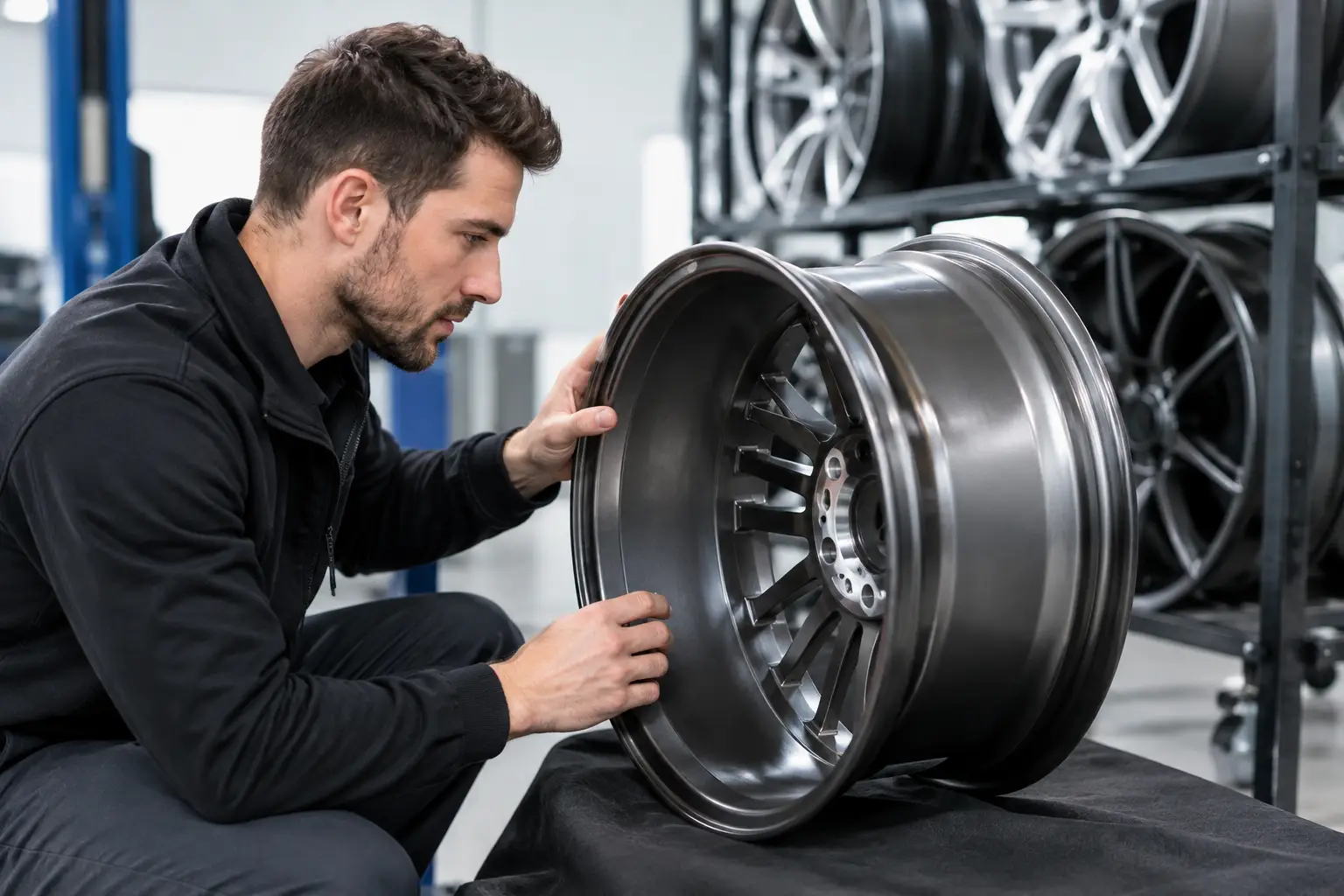
A wheel can have the right diameter, the right stud pattern and tyres that appear to fit, yet still foul a suspension arm or sit outside the arch. That is why you need to check wheel offset before ordering alloys, used wheels or replacement rims. Offset affects where the entire wheel sits in relation to the hub, so a few millimetres can make the difference between a clean fit and an expensive problem.
For everyday replacement wheels, staying close to the vehicle manufacturer specification is normally the safest route. For an aftermarket upgrade, there can be room to change the offset, but it must be considered alongside wheel width, tyre size, brake clearance and available arch space.
What wheel offset means
Wheel offset is the distance between the wheel’s centreline and its hub mounting face. It is measured in millimetres and is usually stamped on the back of the wheel as ET, followed by a number. For example, ET45 means the mounting face sits 45mm towards the outer face of the wheel from its centreline.
A positive offset is most common on modern front-wheel-drive, rear-wheel-drive and four-wheel-drive vehicles. The higher the positive ET number, the further inboard the wheel sits. A lower ET number moves the wheel outward towards the arch.
This is often confused with wheel width. An 8J wheel and a 9J wheel can both be ET35, but the 9J is an inch wider overall at the bead seats. If it is fitted without changing the offset, it extends roughly 12.7mm further inwards and 12.7mm further outwards than the narrower wheel. Offset alone never tells the whole story.
How to check wheel offset on your current wheels
The quickest starting point is the marking cast or stamped into the rear of your existing alloy wheel. Remove the wheel if necessary and look around the inner barrel, spokes or hub mounting area. You may see a complete specification such as 8J x 18 ET45. In that example, the wheel is 8 inches wide, 18 inches in diameter and has an offset of 45mm.
Do not rely only on an advert, a previous owner’s description or a wheel that looks similar. Manufacturers can use different offsets across the same model range, especially where brake packages, drivetrain layouts and factory wheel widths differ. A BMW, Audi, Mercedes or Range Rover may have several correct wheel specifications depending on year, trim and engine.
If the ET marking cannot be found or is unreadable, a wheel specialist can measure it. Accurate measurement requires the wheel width at the bead seats and the position of the mounting face. The calculation is straightforward in principle, but measuring a wheel with a tape measure from its outer lips can produce the wrong result because the overall rim width is wider than the stated J width.
The vehicle handbook, manufacturer data and the original equipment wheel part number can also help confirm the correct specification. When buying a second-hand set, ask for clear images of the markings on every wheel. Sets are occasionally made up from wheels with similar designs but different widths or offsets.
Check wheel offset with the full fitment specification
Before deciding whether a different ET will work, write down the full specification of the wheels already fitted and the wheels you are considering. You need the diameter, width, offset, PCD, centre bore and bolt or nut seat type. Tyre size matters too, as a wider or taller tyre can create rubbing even when the wheel itself clears.
PCD refers to the number of fixing holes and the circle on which they sit, such as 5×112 or 5×120. It must match the vehicle unless an engineered conversion is being used. The centre bore should be correct for the hub, or the wheel must be properly centred with suitable spigot rings where appropriate. Bolt seats are equally important: conical, radius and flat-seat fixings are not interchangeable simply because the thread fits.
Load rating should not be overlooked, particularly on SUVs, electric vehicles, vans and performance models. A wheel needs to be rated for the vehicle’s axle loads, not just match its cosmetic style or diameter.
Comparing the new wheel with the old one
When the wheel width stays the same, changing from ET45 to ET35 moves the wheel 10mm outward. This creates 10mm more inner clearance but reduces clearance between the tyre and wheel arch by 10mm.
With a width change, the calculation needs more care. Moving from an 8J ET45 wheel to a 9J ET45 wheel adds about 25.4mm of width, split evenly around the original centreline. The new wheel therefore comes approximately 12.7mm closer to the suspension and protrudes approximately 12.7mm further towards the arch.
If that 9J wheel is instead ET35, it moves a further 10mm outward. Compared with the original 8J ET45 wheel, the inner edge is about 2.7mm further away from suspension components, while the outer edge is about 22.7mm further out. That may look purposeful, but it is also much more likely to contact the arch liner or tyre on full lock and suspension compression.
These figures are useful for narrowing down choices, not as a guarantee. Brake caliper shape, damper position, steering angle, lowered suspension, wheel design and tyre shoulder profile all affect real-world clearance.
Signs the offset is not right
A wheel that sits too far inboard can rub on the suspension strut, inner arch liner, brake hose or steering components. On the front axle, contact may only occur at full lock, which makes it easy to miss during a quick inspection. Marks on the inner tyre sidewall, polished areas on a suspension component or a scraping sound while manoeuvring all need immediate attention.
A wheel that sits too far outboard can catch the arch liner or metal arch edge when carrying passengers, hitting a pothole or travelling over uneven roads. It can also throw more road dirt along the vehicle’s sides and place the tyre outside the bodywork. Excessive protrusion is not simply a styling issue – it can create legal, safety and MOT concerns.
Changes to offset can also alter steering feel. A substantial move outward changes scrub radius, which may increase kickback through the steering wheel and affect how the vehicle behaves under braking on uneven surfaces. Small changes may be acceptable on some vehicles, while the same change can be unsuitable on another. This is why vehicle-specific advice is more useful than a generic claim that a particular ET always fits.
What about wheel spacers?
Spacers reduce the effective offset by moving the wheel outward. A 10mm spacer fitted behind an ET45 wheel gives an effective offset of ET35. They can be useful where a wheel needs extra brake caliper clearance or where a carefully planned fitment requires a small adjustment, but they are not a cure for buying the wrong wheels.
The spacer must be high quality, correctly sized for the hub and installed with suitable longer bolts or studs where required. Hub-centric spacers are generally preferable where the thickness allows, as the wheel should locate correctly on the hub rather than hang on the fixings alone. Wheel bolts must have the correct seat profile and sufficient thread engagement.
Avoid stacking spacers, fitting universal parts without checking the centre bore or using spacers to force a wheel that already sits too close to the arch. After fitting, torque the fixings to the vehicle manufacturer’s specification and recheck them after the initial bedding-in period. You should also tell your insurer about modifications where required by your policy.
Get the fitment checked before tyres are fitted
A bare wheel can be test-fitted to check caliper and suspension clearance, but the final assessment should be made with the correct tyre fitted. Turn the steering from lock to lock, inspect clearances and consider how the wheel moves through suspension travel. On lowered cars, this check is especially important because the usable clearance can be much tighter than on standard suspension.
If you are changing wheel diameter, use an appropriate tyre profile to keep the overall rolling radius close to standard. A large difference can affect speedometer accuracy, gearing, traction-control calibration and arch clearance. For premium and performance vehicles, brake clearance may be the limiting factor even if the offset calculation appears sensible.
For drivers buying wheels in Dorset, The Tyre Barn can check the key fitment details and fit suitable tyres at its Wimborne workshop. Bring the vehicle specification and, if possible, the exact wheel details rather than relying on a photograph or a similar-looking listing.
The best-looking alloy wheel is only a good purchase when it fits safely and drives properly. Check the ET marking, compare width and offset together, and ask for specialist advice whenever the fitment is not clearly vehicle-specific.