
What Causes Uneven Tyre Wear? Key Faults

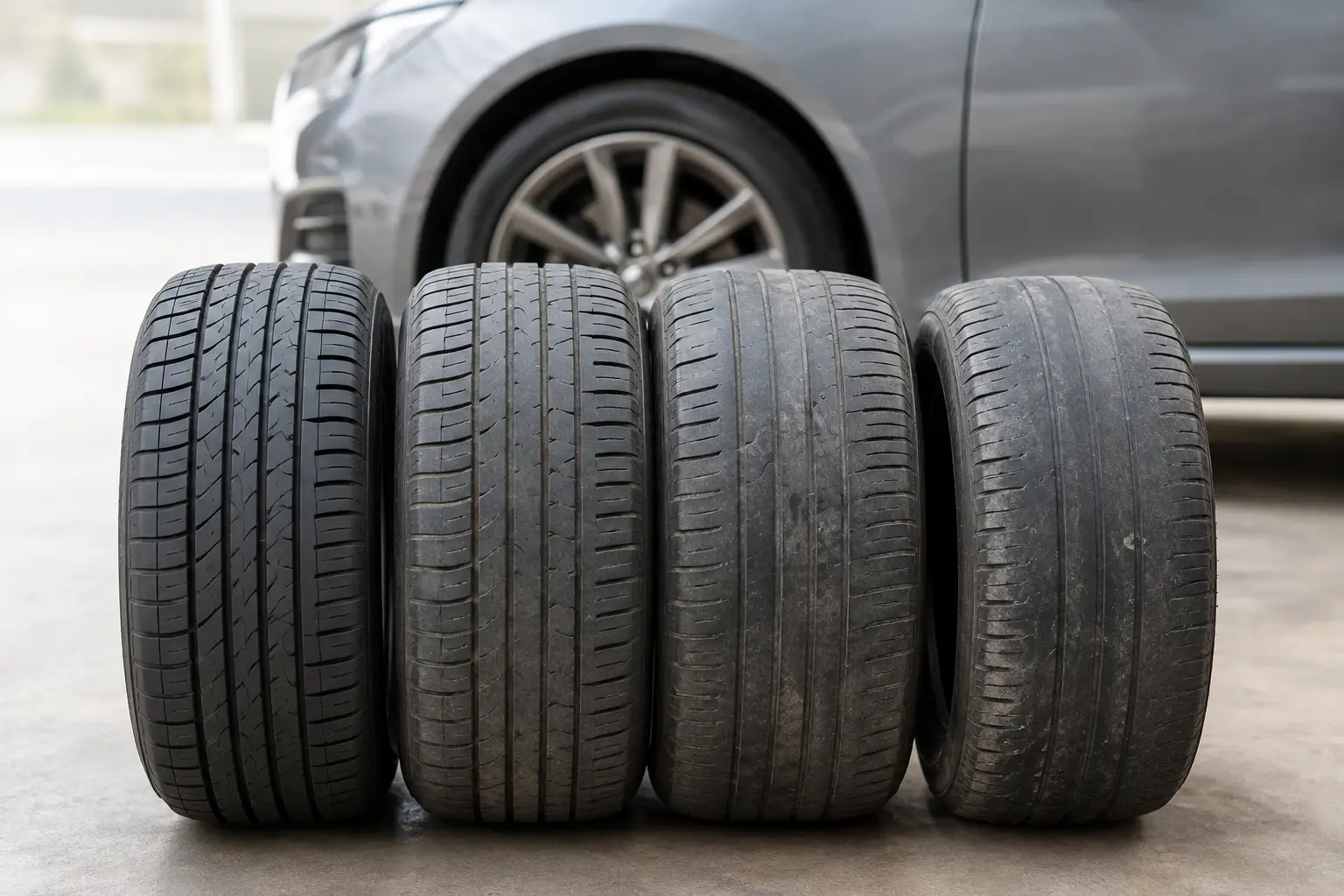
A tyre can look acceptable at a glance, yet be close to the end of its useful life on one inner edge or across a small patch of tread. If you are asking what causes uneven tyre wear, the answer is usually not simply mileage. Tyres wear unevenly when the vehicle is no longer holding the tyre squarely on the road, when inflation pressure is wrong, or when a mechanical fault allows the wheel to move in ways it should not.
The wear pattern is often the clue. Catching it early can save a tyre that still has plenty of usable tread, improve how the car drives and prevent a minor alignment or suspension issue becoming a larger repair.
Why the pattern of tyre wear matters
Tyres are designed to spread the vehicle’s load evenly across the tread. When that contact patch changes, one part of the tyre works harder than the rest. The result may be rapid wear on an edge, a smooth strip through the centre, raised and lowered patches around the circumference, or tread blocks that feel sharp in one direction.
Do not rely only on the visible outer shoulder. On many cars, particularly lowered vehicles and performance models, the inner shoulder can wear first and is easy to miss without turning the steering or removing the wheel for inspection. Run your hand carefully across the tread and inspect both sides of each tyre regularly.
What causes uneven tyre wear on a car?
Incorrect wheel alignment
Wheel alignment is one of the most common causes. Alignment is not just about pointing the front wheels straight ahead. It includes camber, caster and toe – angles that determine how each wheel sits and travels on the road.
Too much negative camber commonly wears the inside shoulder, while excessive positive camber wears the outside shoulder. Toe settings are especially hard on tyres. If the wheels are toed in or out beyond specification, the tread is effectively dragged sideways as it rolls. This can create feathering: one side of each tread block feels smooth, while the other feels sharp.
Alignment can move out after hitting a pothole, clipping a kerb, driving over poor road surfaces or fitting suspension components. A car may still track reasonably straight, so a straight steering wheel does not prove the alignment is correct. Four-wheel alignment is particularly worthwhile on vehicles with adjustable rear suspension, as rear geometry can affect both tyre wear and steering position.
Incorrect tyre pressure
Pressure changes the shape of the tyre’s contact patch. An over-inflated tyre tends to run more heavily on the centre of the tread, causing centre wear. An under-inflated tyre flexes more and loads both shoulders, so the outer edges wear faster. Low pressure also creates excess heat, which is especially undesirable at motorway speeds or when the vehicle is heavily loaded.
Use the pressure stated on the vehicle’s tyre-pressure label or in its handbook, rather than the maximum pressure moulded into the tyre sidewall. Check pressures when the tyres are cold, ideally at least once a month and before a long trip. If one tyre repeatedly loses pressure, do not keep topping it up without investigation. A puncture, leaking valve or corrosion around an alloy wheel bead can all be responsible.
Worn or damaged suspension and steering parts
A wheel can be correctly aligned on the ramp but still change angle while driving if suspension or steering components have play. Worn ball joints, bushes, track-rod ends, wheel bearings, dampers and control arms can allow the wheel to move under braking, cornering or over bumps.
Cupping or scalloped wear around the tyre is often associated with worn dampers, imbalance or looseness in the suspension. The tyre may also become noticeably noisy, producing a rhythmic hum that rises with road speed. A vibration through the steering wheel is another reason to have the wheel, tyre and associated components checked rather than assuming a balance weight has simply fallen off.
Replacing tyres without addressing the underlying play can be a false economy. The new pair may begin showing the same pattern surprisingly quickly.
Wheel damage, poor balance or incorrect fitment
A bent wheel can prevent a tyre from running true, while a damaged rim edge can affect the seal and lead to gradual pressure loss. Pothole damage is not always obvious from the face of an alloy wheel. A slight buckle on the inner barrel may only reveal itself through vibration, a leak or an unusual wear pattern.
Wheel balance is different from alignment. Balancing corrects uneven weight distribution in the wheel and tyre assembly. Poor balance more commonly causes vibration and patchy wear than a clean inner- or outer-edge pattern, but it should still be checked promptly.
Fitment matters too. Wheels with the wrong offset, unsuitable width, missing spigot rings or incorrect fixings can cause clearance, loading and vibration issues. On modified cars, a tyre size that is too stretched or too wide for the wheel can also alter how the shoulders work. The right wheel and tyre combination needs to suit the vehicle, not just look correct in a photograph.
Driving conditions and vehicle use
Not every uneven pattern means something has failed. Frequent roundabouts, tight urban turns and spirited driving can wear the outer shoulders more quickly, especially on a heavy front-wheel-drive car. A vehicle used mainly for short local journeys may also see different wear from one that spends most of its time cruising on dual carriageways.
Load makes a difference. Carrying tools, equipment or passengers regularly without using the recommended laden tyre pressures can shorten tyre life. Commercial vehicles and vans deserve particular attention here, as their tyres experience larger changes in load from one journey to the next.
Front and rear tyres also wear differently. Driven tyres usually wear faster, while steering tyres work their outer shoulders harder. On some cars, tyre rotation can help equalise wear, but only where the tyre type and vehicle manufacturer guidance allow it. Directional tyres must remain on the correct side of the vehicle, and staggered wheel setups cannot normally be rotated front to rear.
Reading common tyre wear patterns
The shape and location of the wear gives a workshop a useful starting point:
- Centre tread worn more than both shoulders usually points to over-inflation.
- Both shoulders worn more than the centre often indicates persistent under-inflation or heavy loading at insufficient pressure.
- One inner or outer shoulder worn is commonly linked to camber, toe or a worn suspension component.
- Feathered tread blocks suggest an alignment issue, particularly toe settings.
- Cupped, scalloped or patchy tread can indicate worn dampers, wheel imbalance, a bent wheel or suspension play.
These are indicators rather than guarantees. For example, an inner shoulder worn smooth may be caused by camber, but excessive toe can make that same wear progress much faster. Proper inspection matters because the fix should match the cause.
When uneven wear means replace the tyre
In the UK, the legal minimum tread depth is 1.6mm across the central three-quarters of the tyre’s breadth, around its full circumference. However, a tyre can become unsuitable before the visible main grooves reach that limit. If one shoulder is worn down to the tread-wear indicators, if cords are visible, or if there is a bulge, cut or structural damage, it needs replacing.
It is sensible to consider replacement before tyres reach the legal minimum, particularly for wet-weather performance. Many drivers choose to replace at around 3mm because water clearance and wet grip reduce as tread becomes shallow. The right point depends on the tyre, season, vehicle use and the conditions you regularly drive in.
Where only two tyres are being replaced, the new or better-tread pair should generally be fitted to the rear axle to help maintain rear-end stability in wet conditions. There can be vehicle-specific exceptions, so check the manufacturer’s recommendation and seek advice if you run different wheel widths front and rear.
Stop the next set wearing the same way
Ask for the tyres, wheels, alignment and suspension to be assessed together. Fitting new tyres before checking a badly worn inside edge may solve the immediate problem but not the reason it happened. A reliable inspection should include tread measurements across each tyre, pressure checks, wheel condition, balance where needed, and checks for movement in steering and suspension joints.
For drivers in Dorset, The Tyre Barn can inspect tyre wear, advise on suitable replacements and check the wheel and tyre fitment before fitting. This is particularly valuable for alloy-wheel upgrades, repaired wheels and cars with a performance or lowered setup, where small geometry changes can have a large effect on tyre life.
Your tyres are one of the clearest indicators of how the car is behaving on the road. Check them before the warning is a vibration, a failed MOT or a tyre that has worn out long before it should have.